Portable VMS buying is a field-deployment decision first, not just a display-spec decision. For highway work zones, the right unit has to balance visibility, runtime, mobility, and durability without adding avoidable setup downtime. That matters most when the sign will be moved often, exposed to weather, and expected to return to service quickly after each relocation.
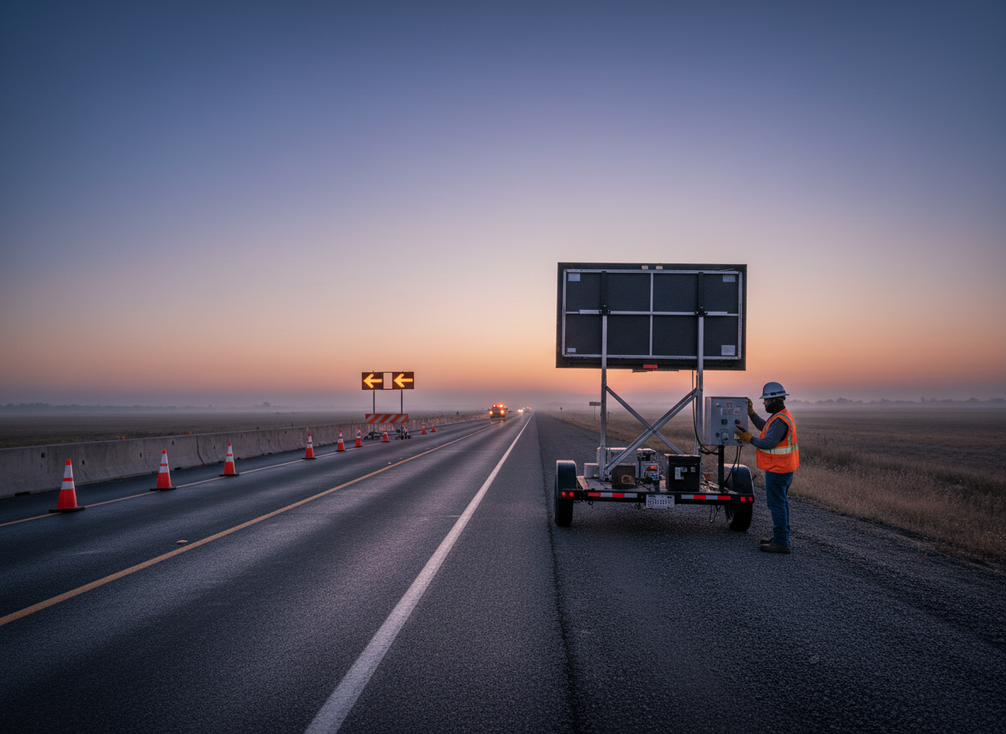
What Portable VMS Buyers Need to Solve
Portable units are chosen for temporary roadside use, not permanent mounting. That changes the buying question: you are not only comparing the screen, you are comparing how the trailer, power system, and controls behave under repeated towing, setup, and shutdown.
For most contractors, the best fit is the sign that stays readable, moves easily, and does not create extra crew time at each stop. A fixed or gantry-style system is more appropriate when the location is stationary and the infrastructure can support a permanent installation. If you want a browsing path for portable options, start with portable VMS options.
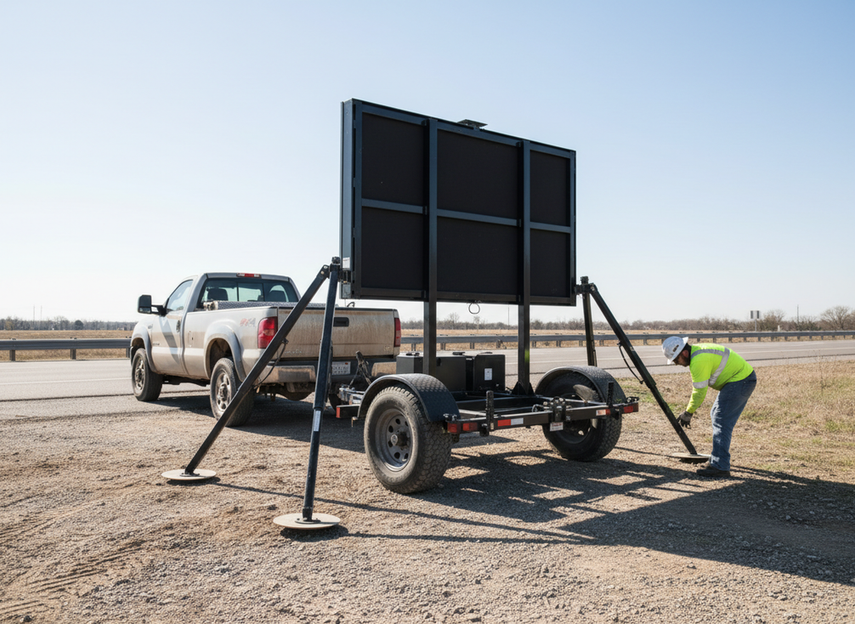
Trailer Stability and Wind Exposure
Stability is one of the first checks because a portable VMS can look fine on paper and still be awkward in the field. The practical questions are simple: how does it sit on uneven shoulders, how easy is it to level, and what happens when the job is exposed to wind or frequent repositioning?
Trailer Base, Leveling, and Parking Setup
A stable base reduces setup error on shoulders, pull-offs, and other temporary parking areas. Look for hitching, braking, outriggers, or leveling features that make the trailer easy to position without repeated adjustments. That matters most on jobs with lane shifts or rolling maintenance, where the crew may need to move the unit more than once in a shift.
Mast, Cabinet, and Panel Stability
The structure should handle towing vibration and repeated transport without loosening the display or shifting alignment. Buyers should inspect how the cabinet is attached, how the panel is retained, and whether the hardware is designed for frequent movement rather than occasional relocation. A sign that seems solid while parked can still be a poor fit if transport wear creates downtime later.
Wind Load Checks and Site Conditions
Wind exposure changes with corridor openness, grade, shoulder width, and nearby traffic. Do not treat a single wind figure as universal proof. Ask for the stated test basis, configuration, and operating limits, then match that to the actual job site. FHWA’s deployment height requirements also show why field setup details matter, with operating height differing by urban and rural context.
Crash-test history can also affect fleet decisions. FHWA’s crashworthiness standard transition means procurement teams should confirm what standard the unit was tested under and how that affects replacement timing for the trailer hardware.
Power, Runtime, and Brightness Retention
Runtime is not a single number that you can compare in isolation. It is a workflow fit question tied to shift length, recharge access, brightness setting, weather, and how often the unit is moved. The MUTCD 11th Edition sets the visibility baseline for day-and-night visibility requirements, so battery planning only matters if the message stays legible in the conditions your crews actually face.
Battery Capacity for Shift Length
Match battery capacity to the operating window you need between charging opportunities. Cold weather, long idle periods, and repeated travel can shorten real-world runtime, so a headline autonomy claim is less useful than the question, "Will this cover the actual shift and move cycle?" If the battery is hard to access or slow to service, downtime can become a recurring issue.
Solar Support and Recharging Workflow
Solar support is helpful when the deployment pattern leaves enough exposure and enough time for recharge, but it is not an automatic guarantee of uninterrupted service. Check whether the unit can recover charge during short-duration jobs, shaded placements, or winter use. For many buyers, solar is a continuity feature, not a substitute for a full operating plan.
Brightness Retention in Daylight and Night
Outdoor legibility depends on more than peak brightness. Viewing distance, sun angle, message contrast, and after-dark performance all affect whether drivers can read the message in time. In practice, the right question is whether brightness still holds after long outdoor exposure and transport, not whether the spec sheet lists a large number. If you are comparing broader categories, the C-Tra-VMS series is a useful place to check current configurations.
Quick-Deploy Features That Cut Downtime
Quick-deploy features matter because every minute spent on setup is a minute not spent on traffic control. The useful question is not, "Is it easy?" but, "How many steps does the crew need from arrival to a live message?" ODOT’s message timing practices also remind buyers that controller and message workflow affect real use, not just convenience.
- Arrival and positioning. The first check is towability and parking simplicity. If the trailer is hard to spot, align, or secure, the rest of the process slows down.
- Lift or deployment. Hydraulic or assisted lift features can reduce manual friction, but only if the system is easy to control and clearly laid out for the crew.
- Message programming or update. Accessible controls and a simple interface matter when the crew needs to change a message quickly and move on.
- Stow-and-move. The best quick-deploy setup is the one that also packs down cleanly, with little rework before towing to the next location.
For crews that need a more mobile setup, the vehicle-mounted VMS can reduce trailer handling. For jobs that stay on a shoulder for longer periods, a solar trailer model may fit the workflow better, but only if the site conditions support that style of deployment.
Match the Spec to the Work Zone
The safest way to compare portable VMS is to map the job pattern first, then decide which feature matters most. Short closures, frequent relocation, exposed sites, and overnight use do not all ask for the same balance of stability, runtime, and deployment speed. Portable signs placed in the clear zone may also need extra delineation if they are not protected by barrier or guardrail, which is why setup planning matters as much as the equipment itself.
| Job Pattern | Priority Feature | What To Verify | Risk Note |
|---|---|---|---|
| Short lane closure | Quick deployment and simple controls | Arrival time, message update workflow, easy stow | A unit that is slow to program can create avoidable downtime |
| Frequent relocation | Towability and repeatable setup | Hitching, leveling, and transport stability | Repeated moves can expose weak hardware or awkward controls |
| Windy exposed site | Trailer stability and test basis | Stated deployment limits and configuration | A wind figure without context may not match the actual site |
| Overnight visibility need | Power and brightness retention | Recharge plan, battery access, legibility in dark conditions | Runtime that works in daylight may not hold after dark |
Traffic & VMS LED Display is the best browse path if you are still narrowing the category, while a gantry sign alternative is more relevant when the job starts to look permanent rather than portable.
Final Selection Checklist
Before you request a quote, confirm the tow setup, site conditions, runtime plan, visibility target, and wind exposure. Ask how the unit is serviced in the field, how fast it can be returned to service after a move, and what documentation supports the setup limits. If the answer is vague on any of those points, the sign may be a poor fit for active highway work.
FAQs
What Makes a Portable VMS Reliable for Work Zones?
Reliability comes from the full setup, not just the screen. Buyers should look for stable towing, clear visibility in day and night conditions, realistic runtime planning, and easy service access. A sign that is hard to reposition or hard to recharge can create more downtime than it saves.
How Long Do Solar Portable VMS Units Last Between Charges?
There is no single safe answer for every job. Runtime depends on battery capacity, sunlight, brightness settings, weather, and how often the unit is moved. The better buying question is whether the operating window matches the actual shift and recharge cycle for your work zone.
How Do You Compare Wind Resistance for Portable VMS?
Treat wind resistance as a site-fit question, not a slogan. Ask what test basis was used, what configuration was tested, and what operating limits apply to the trailer in the real deployment environment. That is more useful than a lone number without context.
What Setup Features Reduce Downtime on Highway Jobs?
The biggest time savers are usually towability, easy leveling, straightforward lift or deployment controls, and a simple message-update workflow. If the crew has to fight the controls or repeat setup steps, the equipment can slow the job even if the display itself is strong.
Can a Portable VMS Replace a Permanent Highway Message Sign?
Sometimes, but only when the job pattern is temporary and mobile. Portable units fit relocating work zones and short-duration control needs better than permanent systems. Fixed installations make more sense when the location is stable and the infrastructure supports a permanent solution.