


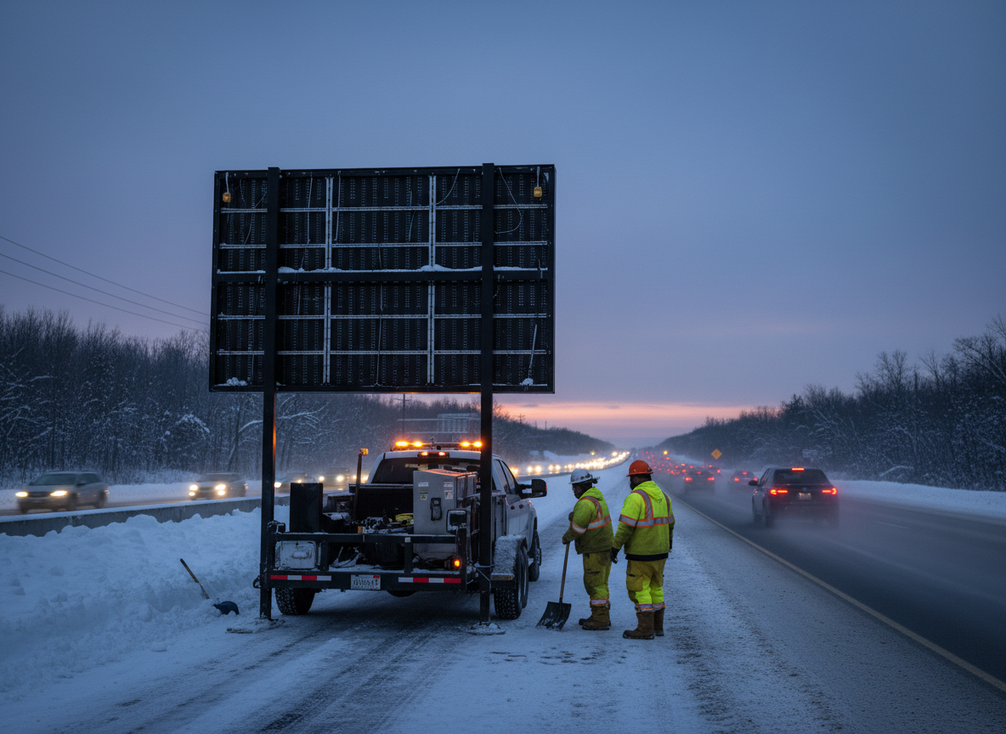
Highway VMS TCO and winter performance should be judged as one procurement problem, not two separate ones. The lowest bid can still cost more over time if installation, power, maintenance, spares, or winter recovery are weak. For highway use, the MUTCD visibility standard is only the starting line, not the whole ownership picture.
Why Upfront Price Misses the Real Cost
The first mistake in highway VMS buying is treating purchase price as if it were the full cost. A better model separates acquisition, installation, energy, maintenance, repairs, spare parts, service response, and eventual replacement. That matters because two bids can look close on paper and still diverge once the agency adds transport, commissioning, site work, and downtime risk.
A practical rule is this: if a quote does not show the scope clearly, it is not yet comparable. That is especially true for highway VMS TCO and winter performance planning, where winter uptime can affect both operating cost and traffic-management workload.
For readers comparing display families, a broader traffic VMS display options page can help organize the category, but it should not replace a written scope review.
What Drives Highway VMS Total Cost
Acquisition and Installation Costs
Acquisition cost varies sharply by structure type and deployment context. One recent DOT tech sheet shows small units around $30,000, while mainline overhead installations can exceed $365,000, which is a reminder that the sign body alone never tells the full story. See the capital cost benchmark.
Normalize the bid before you compare the number. Ask whether the proposal includes transport, mounting, commissioning, field wiring, structural work, and any controller integration. A gantry sign solution may carry different install assumptions than a portable unit, so price comparisons only make sense after the scope is lined up.
Power and Energy Costs
O&M is a real lifecycle line item, not a rounding error. The Michigan ITS evaluation puts annual O&M at roughly $2,300 to $8,900 per device depending on density and location, which is why buyers should model power, visits, and repairs separately from purchase price. That annual O&M benchmark is useful background, not a universal rate.
This is where winter matters. A solar trailer, for example, may look inexpensive on day one, but the operating picture changes if winter charging is weak, duty cycles rise, or the sign spends long periods idle between deployments. If the system depends on seasonal solar input, the buyer should compare the real operating profile, not the optimistic nameplate assumptions. For a solar trailer VMS, the key question is whether the quoted power model still works in the months when sunlight is least reliable.
Maintenance, Repairs, and Spares
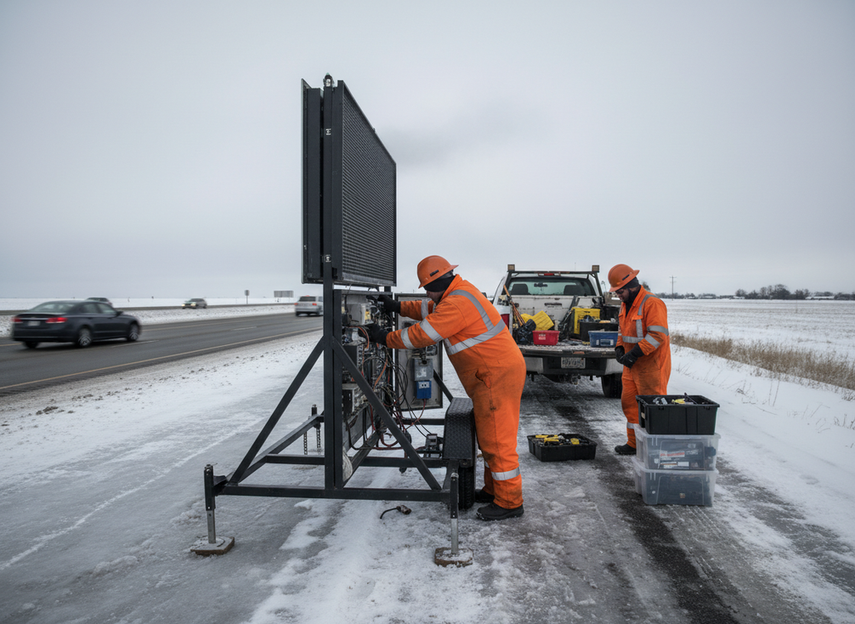
Maintenance cost is not only about routine service. It also depends on how quickly the agency can swap parts and get the sign back online after a fault. Front-service access, modular repair, and stocked components can shorten downtime and reduce labor, especially when a crew is working in bad weather or on a narrow shoulder.
The practical buyer question is simple: what is stocked, what is custom, and what has lead time? If the supplier cannot answer that in writing, the apparent savings may disappear the first time a winter repair is delayed. That is a core part of highway VMS TCO and winter performance, because downtime itself becomes an operational cost.
Service Response and Replacement Timing
Service terms can change the real cost more than many teams expect. Response time, warranty scope, escalation paths, and spare-parts commitments affect how long the sign stays offline after a failure. The same is true for replacement timing: one vendor may assume a longer useful life, while another expects earlier swap-out, which changes lifecycle cost even if the quote looks similar.
A conservative decision sentence applies here: if a proposal depends on slow service or vague parts support, it is cheaper only until the first storm or fault. For vehicle-based deployments, check vehicle-mounted VMS options only after you know whether the service model fits your maintenance plan.
How Winter Conditions Change Performance
Low Temperature and Battery Behavior
Cold weather can materially reduce usable battery capacity. In one cold-climate engineering guide, standard LiFePO4 batteries lose about 40% to 50% of usable capacity at -20°C (-4°F), which is enough to change autonomy planning for portable or solar-powered signs. Review the battery cold-derating threshold before you accept a winter autonomy claim.
That does not mean every battery behaves the same way, but it does mean winter assumptions should be based on realistic temperatures and duty cycles, not a mild-weather test. If a supplier gives you an autonomy number, ask what temperature basis was used and whether that number still holds during a cold snap.
Snow, Ice, and Visibility
Winter solar input can fall sharply. MnDOT research reports that solar panels may produce only about 5% to 10% of rated output under dark, overcast winter conditions, which is why winter sizing should never rely on summer averages. See the winter solar output drop.
The display surface matters too. Snow buildup, ice, glare, and condensation can make a sign harder to read even if the battery is fine. A clear procurement check is whether the supplier’s winter discussion covers the visible face of the sign, not just the power system underneath it.
Environmental ranges are useful screening criteria, but they are not a guarantee of site-level uptime. NYSDOT’s VMS environmental and hardware requirements are a good reminder that hardware limits and field performance are not the same thing. Review the environmental operating range as a baseline, not a promise.
Access, Uptime, and Recovery Time
In winter, the biggest issue is often recovery time, not survival. A unit can meet a broad temperature range and still create problems if a storm blocks access, if a plow strike delays repair, or if the crew cannot reach spare parts quickly.
That is why winter planning should include service procedures, access assumptions, and restoration expectations. If the team cannot get the sign back online fast enough after a fault, the operational cost rises even when the hardware itself is technically acceptable. For agencies comparing winter-ready VMS options, recovery planning should be part of the spec review, not an afterthought.
How to Compare Supplier Proposals
Use the table below to normalize bids before scoring them.
| Bid normalization factor | Vendor / proposal name | Offered value | Normalized basis for comparison | Procurement note for fair comparison |
|---|---|---|---|---|
| Capital cost | Include sign body, mounting, transport, commissioning, and site work | Compare scope, not just sticker price | ||
| Annual O&M | Model routine service, visits, and repair burden per year | Ask for the maintenance assumptions behind the number | ||
| Five-day autonomy | Use the same autonomy basis across bids; NYSDOT uses a five-day benchmark for solar-powered portable VMS | Clarify whether the battery basis is winter-capable | ||
| Environmental range | Compare stated operating range as a screening limit, not proof of uptime | Ask what test conditions support the claim | ||
| Winter battery derating | Compare the temperature basis used in autonomy estimates | Request the cold-weather assumption in writing | ||
| Solar winter output drop | Compare the winter solar input basis, not annual average production | Confirm the low-light assumption used for sizing | ||
| Spare-parts plan | Compare stocked parts, lead times, and repair workflow | Written parts access reduces downtime risk | ||
| Service response | Compare response time, escalation, and recovery process | Slow service can erase upfront savings |
A fair comparison is not a scoring contest first. It is a scope-normalization exercise. Once the bids use the same assumptions, then a procurement team can judge whether a higher price is really a higher cost or just a more complete offer.
What to Verify Before You Buy
Before award, ask for the winter test basis in writing, including the temperature and duty-cycle assumptions behind any autonomy claim. Confirm battery sizing and recharge assumptions, especially for solar or portable units. Request a spare-parts list with lead times, not just a promise of support.
Also verify service response, warranty scope, installation responsibility, documentation set, and acceptance criteria. If the proposal mentions environmental compliance, treat it as a screening step and check current specs rather than assuming it proves site performance. A traffic VMS category page can help with browsing, but the contract should rest on written conditions.
Final Decision Checklist for Winter Deployment
The safest next step is to compare scope, winter assumptions, service terms, and acceptance criteria before you request quotes or approve a purchase. If those items are not written down, the cheapest bid can become the most expensive once winter, repairs, and downtime are counted. Use the comparison table as your internal review sheet, then confirm what the supplier will support in writing before award.
FAQs
How Do You Compare Highway VMS Total Cost of Ownership?
Break it into acquisition, installation, power, maintenance, spares, service, and replacement timing. Then adjust for winter access and downtime risk. If two bids look close, the one with clearer service terms and better spare-part access is often easier to own, even if it is not the lowest upfront number.
What Winter Specs Should Buyers Request for Highway VMS?
Ask for the temperature basis behind autonomy claims, the winter solar assumption, the battery derating logic, and the recovery process after a fault. Also ask whether the quoted operating range is a test limit or a site-specific promise, because those are not the same thing in winter procurement.
Why Does Battery Sizing Matter for Solar VMS Trailers?
Battery size matters because winter sunlight can be weak and cold temperatures can reduce usable capacity. A trailer that seems adequate in mild weather may not hold the same margin during storms, long idle periods, or repeated deployments. The key is to compare autonomy under the same winter assumptions, not just battery nameplate size.
Can Spare Parts Availability Change VMS Ownership Cost?
Yes. If a supplier cannot stock common parts or deliver replacements quickly, downtime gets longer and the agency absorbs extra labor and operational disruption. Spare-parts planning is part of the TCO model, not just a warranty detail, especially when winter access is limited and recovery time is tight.
What Should a DOT Ask Before Awarding a VMS Contract?
Require the bidder to state scope, winter assumptions, service response, warranty coverage, spare-part access, and acceptance criteria in writing. If any of those are vague, the proposal is not fully comparable yet. That one step often prevents the most expensive mismatch: a low bid that is missing the support needed to keep the sign online.





