


Common cathode is worth a close look when an outdoor billboard runs long hours and electricity is a meaningful part of the budget. Its energy-saving opportunity comes from the drive and power design, not from a change to the content workflow. Compare two actual configurations at the same brightness and content, then calculate electricity, cooling and service costs over five years.
What Is Common Cathode LED Technology, and How Does It Work?
A billboard’s power architecture can make a lasting difference to its electricity bill. The useful purchasing question is how much the complete display draws under your operating schedule—not just which circuit label appears in the brochure.
Common Cathode vs. Common Anode: The Core Difference
Common anode means LED anodes share a common connection. Many conventional designs use a shared supply rail for RGB, leaving more voltage to be dissipated in the drivers for lower-forward-voltage colors. Supply topology and driver efficiency still vary between products.
Common cathode means LED cathodes share a common connection. Energy-saving implementations can use lower, color-appropriate supply rails, often separating red from green/blue, to reduce driver losses. The benefit depends on the complete power and driver design; it does not require three independently regulated supplies in every product.
| Dimension | Common Anode | Common Cathode |
| Voltage supply | Single shared voltage for R, G, B | Color-appropriate supply rails in energy-saving implementations |
| Wasted voltage | Dissipated as heat across all channels | Minimized per channel |
| Typical power saving | Baseline | Lower draw; magnitude is a model-claim to verify |
| Operating temperature | Higher, active cooling often required | Potentially lower; cooling design remains model- and site-dependent |
| LED stress level | Higher, accelerated degradation | Potentially lower thermal stress; lifetime depends on components and operation |
| Upfront panel cost | Lower | Higher than common anode; current quotation required |
The attraction is reducing avoidable electrical losses. Translate that advantage into comparable operating watts before adding any cooling or maintenance savings to the business case.
How Precise Voltage Control Works in Practice
For outdoor DOOH projects, Chipshow applies Common Cathode architecture in selected outdoor LED display series such as C-Slim and C-Fit, where lower heat output, reduced energy consumption, and long-term brightness stability are key design priorities.
Lower supply losses can reduce cabinet heat, but fanless operation still depends on the enclosure, ambient temperature, solar load and airflow. Review the selected model’s thermal design against the outdoor environmental requirements; common cathode is not by itself a promise that air conditioning can be removed.
Outdoor LED Billboard Operating Cost (TCO): A Five-Year Breakdown
Purchase price appears once on an invoice. Electricity, cooling, and maintenance costs accumulate every month for the life of the installation. Three cost factors compound over a five-year ownership period.
Lower Power Consumption: What Actually Drives the Electricity Line
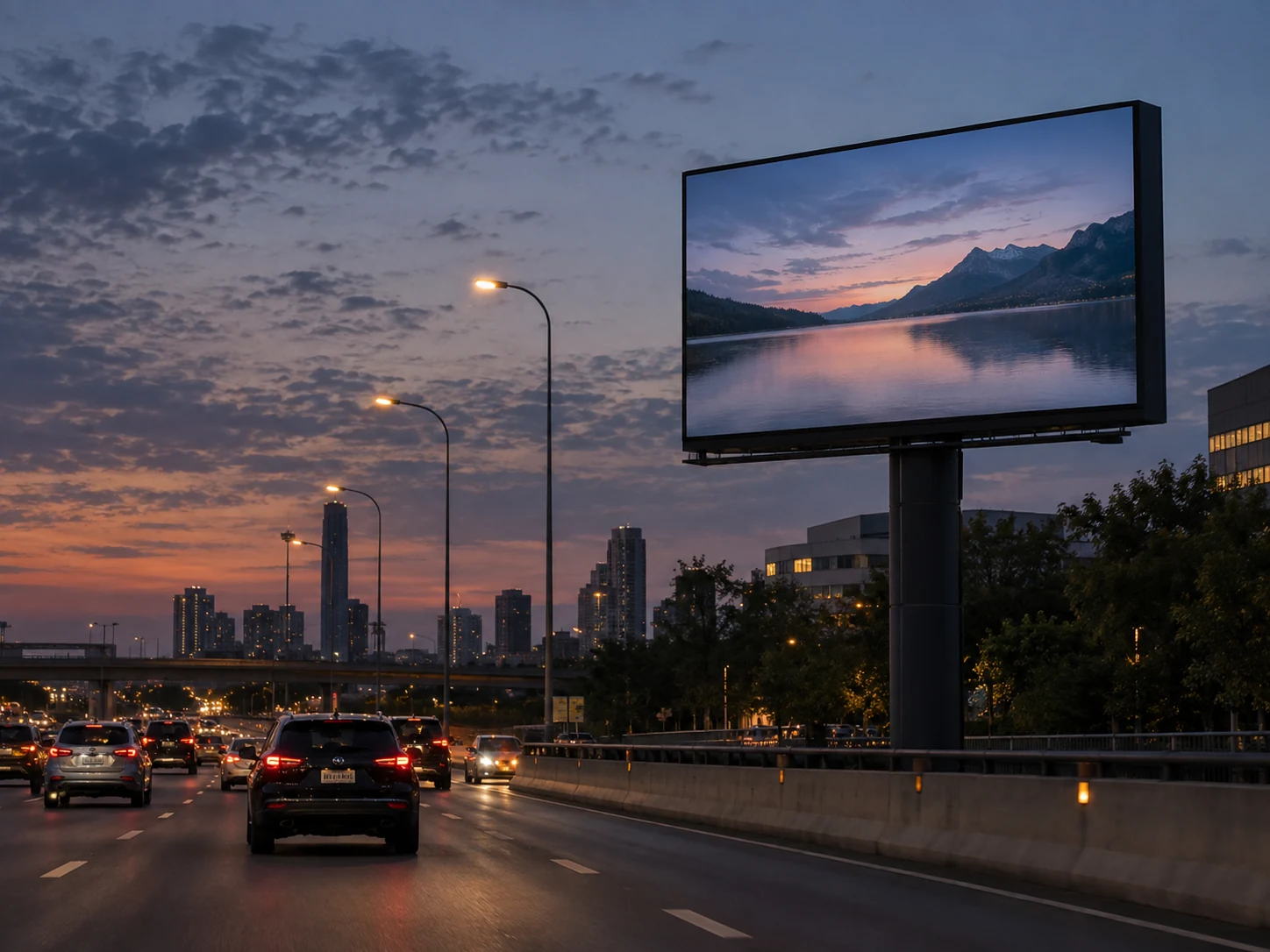
Worked example, not a measured product result: compare a 50 m² billboard averaging 8 kW with one averaging 6 kW at equivalent content and brightness. At 12 hours/day and 365 days/year, the 2 kW difference saves 8,760 kWh annually. At $0.15/kWh, that is $1,314/year or $6,570 over five years, before tariff changes, cooling and service. Use the actual offers’ comparable average draw in place of these example inputs.
Reduced Heat Generation: Where Cooling Costs Drop
Lower display heat can reduce cooling demand, particularly in enclosed or high-temperature installations. Whether the site needs fans, heat exchange or air conditioning depends on solar gain, enclosure design and the equipment’s temperature limits. Ask for the cooling arrangement with each quotation and price only the savings that arrangement supports.
Extended Operational Half-Life: The Compounding Effect of Cooler Operation
LED operational half-life is the point at which brightness drops to 50% of initial output. Junction temperature, the heat level inside the LED chip itself, is a primary factor in how quickly that threshold is reached. Lower operating temperatures reduce thermal stress on LEDs, solder joints, and driver circuits, slowing degradation and extending the interval before brightness falls below acceptable levels. This defers module replacement costs over the ownership period. Electricity savings, reduced cooling costs, and deferred replacements build on each other over five years.
How Does a 5-Year ROI Comparison Actually Look?
A cost model over five years is more useful than any single specification. The table below uses a 50 sqm outdoor billboard running 12 hours per day, 365 days per year as a reference scenario.
| Cost Category | Common Anode (5 Years) | Common Cathode (5 Years) |
| Hardware purchase premium | Baseline | Use the difference between installed quotations |
| Electricity cost | Baseline | Calculate from comparable operating kW and hours |
| Active cooling operation | Use the specified enclosure cooling design | Often reduced or eliminated |
| Maintenance visit frequency | Baseline | Use the quoted service scope; no automatic saving |
| Module replacement timing | Standard degradation cycle | Model from the proposed maintenance and replacement plan |
| Total 5-year operating cost | 100% (baseline) | Lower; run your own site-specific model |
This table identifies cost inputs rather than predicting a universal percentage saving. Keep electricity, cooling and replacement assumptions visible so the budget can be updated when the quotations arrive.
Simple payback equals the installed premium divided by annual net savings. In the electricity-only example above, a hypothetical $5,000 premium divided by $1,314/year gives about 3.8 years. Doubling daily hours doubles that example’s energy saving if average draw is unchanged. Compare model-level offers from the C-Slim and C-Fit Easy ranges with the same schedule, rather than carrying a generic payback window into the quote.
What Drives the Payback Timeline
Three site factors accelerate payback.
- Electricity tariffs above local commercial averages compress the timeline significantly.
- Around-the-clock operation doubles the annual electricity saving versus a 12-hour schedule.
- Where the proposed cooling design uses less energy, add that separately to the annual saving.
Sites combining two or more of these factors reach payback faster.
Operational Benefits Beyond Energy Savings
Lower power draw delivers the primary financial return, but three additional factors matter for long-term network management.
Improved Color Uniformity Over Time
Lower thermal stress can support color stability, but uniformity also depends on LED binning, calibration, driver behavior and operating history. Compare low-gray content and a replacement module on the actual display; voltage topology alone does not establish a color-uniformity advantage.
Lower Failure Rates and Fewer Unplanned Service Visits
Reducing thermal stress can support reliability. To put a value on fewer site visits, compare the service and replacement plans in the actual offers. Access costs matter particularly for roof-mounted or remote billboards, where a straightforward module swap may still require expensive mobilization.
Reduced Electricity Consumption for ESG Reporting
Any reduction in power draw reduces electricity consumption proportionally. For DOOH operators with carbon reporting obligations or sustainability commitments, this reduction is documentable under standard energy reporting frameworks and requires no change to content schedules or operational procedures.
Which Sites Make Common Cathode the Right Specification?
Common Cathode technology delivers its strongest return under specific site conditions. These criteria identify where it belongs as a baseline requirement rather than a premium option.
- Extreme heat environments with sustained ambient temperatures above 35°C (95°F) place continuous thermal load on outdoor cabinets. Common Cathode panels with aluminum cabinet convection reduce active cooling requirements under these conditions. This applies to high-ambient-temperature markets including parts of the Middle East, North Africa, Southern Europe, and Australia.
- Continuous 24/7 advertising networks accumulate electricity costs faster than part-time installations. The electricity saving grows with every additional hour of operation, making always-on DOOH networks a primary use case for this technology.
- High-tariff electricity regions make every saved kWh more valuable. Use the current commercial tariff, including any relevant demand charges, to calculate the return.
- Enclosed or roof-mounted steel structure installations have restricted airflow. Cabinet ambient temperature in enclosed structures can run 5–15°C (9–27°F) above outdoor ambient. Lower heat generation reduces thermal throttling risk and premature driver failure in these constrained conditions.
- Networks with ESG or energy compliance reporting requirements benefit from quantifiable electricity reductions without operational complexity.
Specify the Right Outdoor LED Display Before Your Next DOOH Deployment
Common cathode can make a compelling ownership-cost case when the selected design reduces operating watts without sacrificing the required image. Send Chipshow the billboard area, brightness schedule, daily hours and local tariff, and request a comparison based on the proposed models. Use the outdoor billboard TCO guide to include installation, cooling, maintenance and access alongside electricity.
FAQs About Common Cathode Outdoor LED Displays
Q1. Does Common Cathode Technology Affect Color Accuracy or Grayscale Performance?
Common-cathode power design can reduce losses and heat, which may support stable operation. Color accuracy and low-brightness grayscale still depend on LEDs, drivers, calibration and processing. Compare the same gradients and color content on the proposed displays rather than assuming a universal image-quality gain from the power topology.
Q2. What Is the Typical Operating Temperature Difference Between Common Cathode and Common Anode Panels?
There is no single temperature difference that applies to all common-cathode and common-anode panels. Compare the offered models at the same brightness, content, ambient temperature and measurement location. Ask whether the reported temperature is at the LED junction, PCB, cabinet surface or exhaust; those readings are not interchangeable.
Q3. Can Common Cathode Technology Be Used for Both Indoor and Outdoor LED Screens?
Yes, but the financial case is strongest for outdoor installations. Outdoor screens operate at higher brightness, longer daily hours, and greater heat exposure, which amplifies the cost reduction across energy, cooling, and maintenance. Indoor installations in controlled environments with lower brightness requirements see a smaller efficiency gain.
Q4. Does Common Cathode Technology Require Different Power Infrastructure or Installation Procedures?
The power-topology change is internal to the display, so a common-cathode system can fit a conventional AC distribution workflow. Still size circuits, protection, cables and connections for the selected system’s input ratings and installation instructions. A lower average operating draw is not a substitute for the rated electrical design load.
Q5. Does the Actual Energy Saving Vary Depending on Content and Brightness Settings?
Yes. Compare average draw over the same playlist, brightness schedule and operating hours. A mostly dark image and a mostly white image can draw very different power even when neither moves, so motion alone is not a useful predictor. Tariff changes the money saved, not the percentage reduction in electrical energy.
Q6. Does Reducing Power Consumption Support Carbon or Energy Reporting Requirements?
Yes. Lower power draw reduces electricity consumption proportionally. For DOOH operators with energy efficiency commitments or Scope 2 reporting obligations (indirect emissions from purchased electricity), this reduction is documentable under standard reporting frameworks without requiring any change to content or operational schedules.





