


COB vs GOB LED display comparison is really a choice about protection versus service access. In 24/7 control rooms, a COB LED display can be the more durability-forward option, but that advantage can come with harder repair workflows. If your room has tight uptime requirements, limited rear access, or a small service team, the maintenance path matters as much as the surface finish.

COB, GOB, and SMD in Control Rooms
For control room buyers, the first question is not just "which one looks best?" It is "which one is easiest to live with for the next several years?" COB, GOB, and traditional SMD differ in how the LED surface is built and protected, and that changes how you plan cleaning, handling, repairs, and spare parts.
A practical way to read the comparison is this: COB is more protection-forward, GOB adds a protective layer over a traditional SMD-style module, and SMD keeps the most familiar service path. That distinction matters in analytical control rooms, where AVIXA’s image system contrast guidance treats fine-detail decision work as a demanding visual task.
Control-room buyers usually judge more than pitch. They also weigh service access, maintenance windows, and whether the team can restore a fault without disrupting the room for long. A mission-critical LED wall may look similar on a spec sheet, but the real difference shows up when a module needs attention and the maintenance window is short.
Where COB Gains Durability
COB’s main appeal is surface protection. In a control room, that can help when the wall sits in a high-touch area, gets cleaned often, or is installed where accidental contact is more likely. The useful judgment is not that COB is invulnerable, but that it is often more resilient to routine handling than exposed-module designs.

That protection matters most in dense fine-pitch walls, where operators sit close enough to notice visual inconsistency but also expect a stable, low-friction surface. In other words, the same environment that makes image quality important also makes front-surface durability valuable.
COB can also make sense in rooms where people routinely move in and out of the work area, or where cleaning teams need to work near the wall on a regular schedule. Those are the places where accidental touches, dust control, and repeated contact are more likely to show up in the service plan.
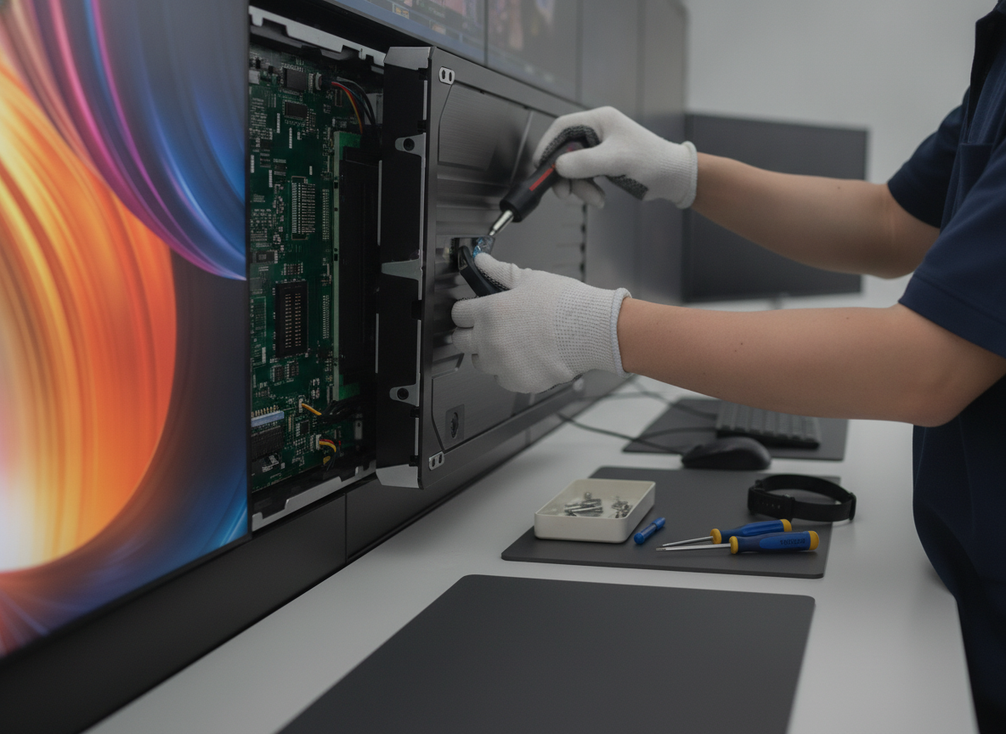
The catch is that protection does not remove the need for access planning. If your installation has limited rear access, front-service design becomes part of the buying decision, because the best surface protection in the world does not help much if maintenance is slow or disruptive.
For buyers comparing fine-pitch COB options, the key question is whether the room needs more resistance to handling risk or more simplicity in field service. That choice flips depending on who will touch the wall, how often it will be cleaned, and how quickly a fault must be cleared.
What Service Tradeoffs COB Still Brings
COB’s service burden is the other side of the durability story. A protected surface can reduce exposed damage, but repairs can become more specialized. In practice, one manufacturer notes that a failed LED in COB is often not repaired cell by cell in the field, and a module swap may be the more realistic path.
Here is the buyer-facing comparison:
| Format | Surface protection | Repair access | Maintenance disruption | Handling risk | Best-fit scenario |
|---|---|---|---|---|---|
| COB | Strongest protection of the three | Often more specialized | Can be higher when a module fails | Lower surface exposure | High-touch or high-contact control rooms |
| GOB | Protection layer over SMD-style modules | Usually closer to familiar SMD service | Moderate, depending on build | Better than bare SMD | Rooms that want a middle-ground protection step |
| SMD | Least protected surface | Most familiar service path | Often simplest to service | Highest exposure | Rooms that prioritize straightforward maintenance |
That is why COB repair challenges are not a rumor so much as a workflow issue. The manufacturer guidance on COB repair points to module-level replacement rather than fine-grained field repair, which is exactly the kind of service reality procurement teams should model before signing.
How Lifecycle Cost Changes the Decision
Total cost of ownership is broader than the quote. It includes purchase price, maintenance effort, downtime exposure, and eventual replacement planning, which is why a room with short service windows can end up paying more for a "cheaper" wall.
The hard part is that lifecycle cost is not only about how often something breaks. It is also about how long a failure stays visible to operators. In a 24/7 room, a harder-to-service wall can raise the cost of even a small fault because the operational interruption is more expensive than the part itself.
That is where spare planning matters. A practical heuristic is to keep enough matching spare modules to protect the visual appearance of the wall, but the exact percentage should be treated as a planning guideline rather than a universal rule. The point is to reduce mismatch risk and shorten the time between failure and restoration, not to promise a fixed savings number.
The TCO framework is useful here because it keeps procurement focused on ownership cost instead of upfront price alone. If you also want a broader mission-critical browsing path, browse command center solutions for category context, but the real decision still comes down to access, service ownership, and downtime tolerance.
Choosing Between COB, GOB, and SMD
- Start with room criticality. If the wall supports operational decisions all day, every day, treat durability and recovery time as primary buying criteria.
- Map physical access. If rear access is limited or maintenance corridors are tight, front-service and module replacement flow matter more than surface marketing.
- Review handling exposure. If the wall will be cleaned often or sits in a high-touch environment, COB’s protection advantage becomes more valuable.
- Check who will service it. If the integrator or facilities team is local and stocked with spares, COB is easier to absorb. If service support is thin, simpler repair paths may win.
- Compare downtime tolerance. If even a small fault is expensive during peak operations, the fastest restoration path matters more than the toughest surface.
- Choose the format that matches the maintenance model, not the one with the most impressive durability claim.
That is the cleanest way to decide whether COB is worth the extra cost for control rooms: use it when protection and fine-pitch performance matter enough to justify a more complex service path. If your room values simpler repair access more than surface resilience, GOB or SMD may be the more practical fit.
Buyer Checklist Before You Commit
- Confirm whether the wall will be front-service, rear-service, or both.
- Identify who is responsible for repairs and what the response path looks like.
- Ask how spare modules will be stored, matched, and replaced.
- Check cleaning, handling, and access procedures for the room.
- Review downtime tolerance for a single failed module.
- Verify the documentation the integrator will hand over for service.
- Make sure the service plan matches the room’s uptime requirement, not just the purchase budget.
FAQs
How Is COB Different From GOB in a Control Room Wall?
COB puts more emphasis on direct surface protection, while GOB is better understood as a protective step over a more familiar SMD-style build. For buyers, the real difference is service behavior: COB tends to lean farther toward durability, while GOB can preserve more familiar maintenance logic.
Why Can COB Be Harder to Repair Than Traditional SMD?
Because the LED surface is more integrated and protected, field repair can become less granular. In practical terms, that means service teams may face module-level replacement instead of a simple local fix. The tradeoff is better surface resilience, not automatic easier maintenance.
Is COB Worth the Extra Cost for 24/7 Control Rooms?
It can be, if the room is high-touch, downtime-sensitive, and difficult to service. If your team has quick access, spare modules, and a clear repair process, COB’s protection advantage may outweigh the added service complexity. If not, a simpler format may be easier to own.
What Should You Check Before Choosing COB for a Mission-Critical Wall?
Check access method, repair responsibility, spare-module planning, cleaning procedures, and response time. Those five factors usually tell you more about ownership cost than the initial quote does. If the service workflow is weak, a durable surface will not fully offset the risk.
Can a Front-Service Design Reduce COB Maintenance Downtime?
It often can in rooms with limited rear access, but only if the full installation and service process support it. Front-service helps most when maintenance windows are short and the wall is hard to reach from behind. The design still needs a clear spare and repair workflow.





