

Securing a networked highway variable message sign is not a certification you can buy off a spec sheet. It is a risk review that starts by mapping every asset and connection that can change the sign’s message or configuration, then applies a hardening baseline, governs remote access, and ends with a documented approve, remediate, or escalate decision.
This is a planning framework, not a compliance guarantee. It will not certify a specific deployment or replace your agency’s legal review, but it gives reviewers a repeatable structure for evaluating VMS cybersecurity requirements across new procurements, existing remotely managed signs, and signs tied into smart-pole or traffic-management networks.
What to Map Before Securing a Networked Highway VMS
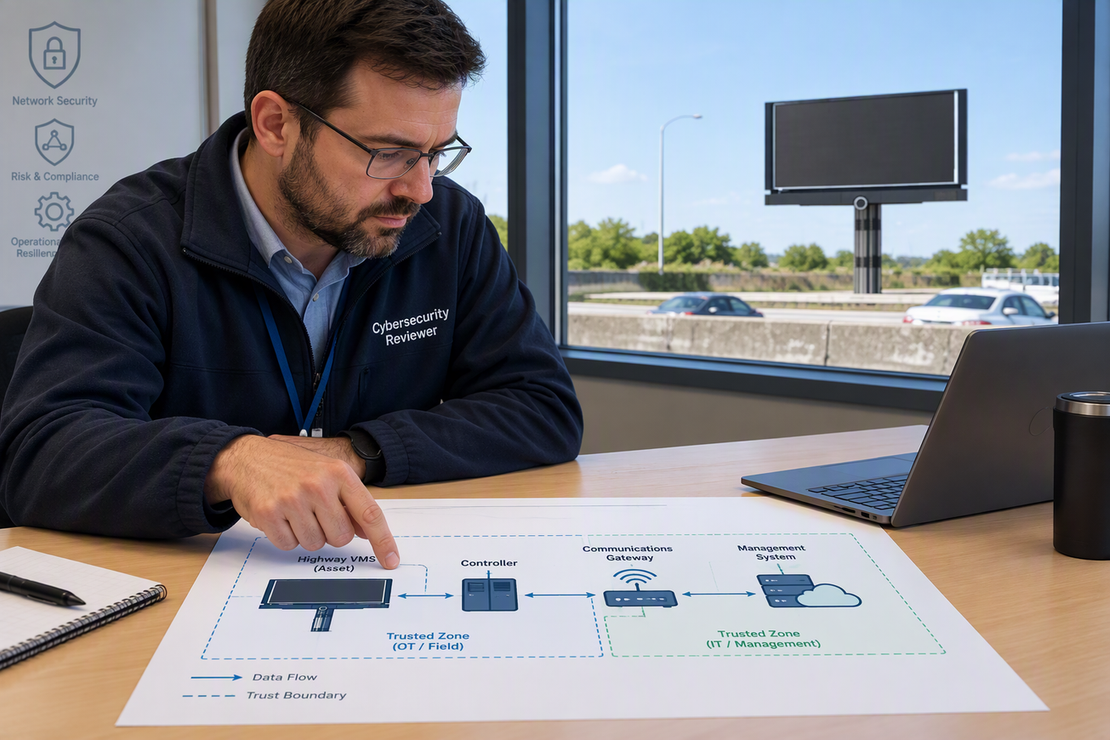
Before selecting any control, a reviewer needs a deployment-specific record of every asset and path that can influence what the sign displays, how it is configured, and who can reach it remotely. That record, not a generic security score, is the first deliverable of the review.
Treat the VMS as an OT-Connected Field Asset
A networked VMS behaves like other operational technology: it interacts with the physical environment and must keep working safely, not just stay "unhackable." NIST’s guide to operational technology security explicitly includes transportation systems within OT and frames OT security and transportation systems around security together with performance, reliability, and safety. That framing matters because a fix that improves cybersecurity but breaks fail-safe display behavior is not an improvement.
The review boundary is the sign plus anything that can configure, command, update, monitor, or maintain it: the controller, any local service port, a communications gateway, a central management platform, and every account with access to those systems.
Build the Asset and Trust-Boundary Record
List each sign, controller, gateway, and management asset along with its connections, accounts, services, owner, criticality, and lifecycle status. CISA’s guidance on updated OT asset inventory recommends an organized, regularly updated list built around an OT-specific taxonomy that classifies assets by function and criticality, which is exactly the record a municipal reviewer needs before picking controls.
- Physical sign, controller, and any local service interface
- Communications gateway, cellular modem, private link, or cloud dependency
- Central management platform and the accounts that can reach it
- Connected smart-pole, traffic-management-center, or vendor maintenance paths
- Owner, location, criticality, and lifecycle status for each item above
Mark where a smart-pole, traffic-management, vendor, cellular, private, or cloud path crosses into a different trust zone. Each crossing is a place where a compromise on one side could reach the other.

Test the Failure Scenarios Before Selecting Controls
An unauthorized command, a loss of availability, a misleading display state, and a loss of remote management are four distinct failure modes, and each one has a different operational owner and response.
- Unauthorized message change: who notices, and how fast can the sign be corrected or blanked?
- Availability loss: does the sign fail to a safe default state, or does it freeze on the last message?
- Loss of remote management: can staff still operate or update the sign locally?
- Recovery delay: how long until a technician can reach the site if remote access fails?
These scenarios also surface manual-operation, fail-safe, backup, and recovery dependencies that the hardening section and approval path will verify later. Our smart city VMS cybersecurity guide covers the same boundary-mapping approach for signs tied into broader smart-infrastructure networks.
OT Hardening Requirements for Networked Highway VMS
Once the boundary is mapped, apply a persistent control baseline that reduces exposure, restricts who can change the sign, and keeps operations recoverable. These are standing requirements, not one-time maintenance steps.
Reduce Exposure and Control Identity
CISA’s mitigation guidance for operational technology recommends removing unnecessary public internet exposure, because internet-facing OT devices are easy targets, and pairing that with strong identity controls. Applied to a VMS deployment, that means:
- Remove any unnecessary public-internet exposure and document the one essential communications path if remote access is required
- Replace default credentials with unique, strong credentials on every device and account
- Apply least privilege so each account can only reach the asset and function its role needs
- Disable dormant accounts and review privileged access as part of routine account lifecycle management
These recommended OT mitigations are a baseline selected for the deployment, not a universal legal requirement; exact thresholds depend on the architecture and the agency’s own policy.
Separate, Monitor, and Maintain the OT Environment
Segment IT and OT networks where the architecture supports it, and document which flows are permitted between them. Require configuration management, logging, monitoring, update responsibility, and a vulnerability-response process as ongoing duties assigned to a named owner, not a one-time setup task. Avoid locking in specific retention periods, encryption algorithms, or patch deadlines unless your agency’s own policy already sets them; those numbers are architecture- and jurisdiction-specific.
Verify Fallback and Recovery Behavior
Manual operation, backup, fail-safe defaults, and recovery procedures should be tested with the actual sign and controller, not just written down. Coordinate any cybersecurity response action with transportation operations staff, because disabling a compromised path or forcing a reboot can itself create a traffic-safety hazard if it is not planned with the people who run the road.
VMS Remote-Access Hardening Checklist
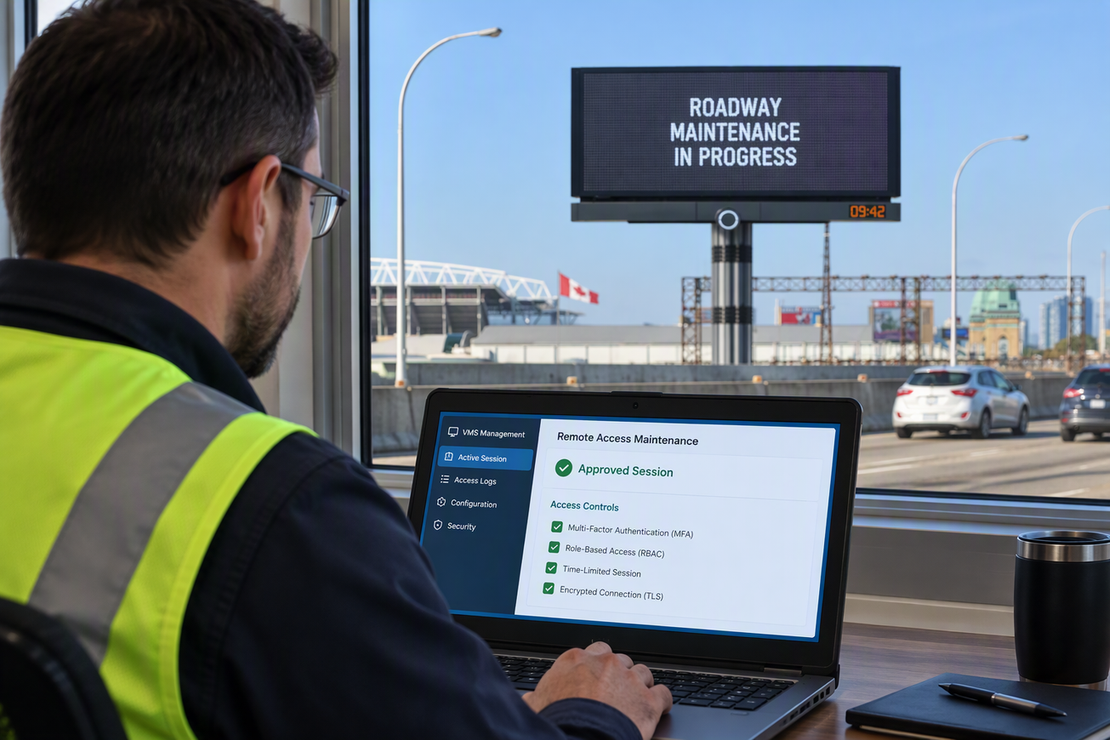
Every remote path into a VMS needs an approved purpose, a named owner, and a bounded scope before a maintenance session starts. This is the article’s one checklist, covering authorization, session control, and closeout.
- Confirm the path’s purpose, owner, endpoint, and the specific asset it is allowed to reach
- Remove unnecessary internet exposure; use a private network connection or VPN for essential remote access
- Require phishing-resistant multi-factor authentication and a unique identity for each user or vendor account
- Apply least privilege so the session can only touch the approved asset and task
- Confirm there are no dormant or shared accounts on the remote-access path
- Log the access attempt, the changes made, and the maintenance window
- Assign responsibility for the resulting update, including who tests and who can roll it back
- Close or expire the access when the session ends and review the log entry
- Confirm the fallback procedure if remote access fails or a change needs to be reversed
CISA’s OT mitigation guidance supports secure remote access guidance built on private connectivity, phishing-resistant MFA, and least privilege for essential remote sessions. Whether a specific VMS product supports these controls out of the box is a separate question the vendor still needs to answer with documentation, not a feature assumption.
Adjust the Review for Three VMS Deployment Scenarios
The right first action changes depending on whether you are procuring a new sign, managing an existing one remotely, or connecting it to smart-pole or traffic-management systems. Use the scenario that matches your situation to prioritize the review.
| Scenario | First review priority | Decision consequence |
|---|---|---|
| New VMS procurement | Require architecture, access, and evidence deliverables in the bid | Award and acceptance depend on verifiable obligations, not general security language |
| Existing remote maintenance | Discover live paths, cut unnecessary exposure, clean up accounts | Remediation gets an owner and a maintenance window before access expands |
| Smart-pole or traffic-management integration | Re-map trust boundaries across shared systems | Each new command path needs its own control and evidence review |
New VMS Procurement
Make cybersecurity requirements, architecture diagrams, remote-access descriptions, and update responsibilities part of the bid package itself, and score responses on verifiable obligations rather than generic assurances of "secure by design."
Existing VMS with Remote Maintenance
Start with discovery: find every live remote path, cut exposure that is not essential, review privileged accounts, and remove dormant ones. Document a remediation plan and a maintenance window with an assigned owner before making further operational changes.
Smart-Pole or Traffic-Management Integration
Map the gateways, management platforms, and communications shared with smart poles or the traffic-management center, and identify who owns each one. Treat every new command or management path introduced by that integration as a trust-boundary change that needs its own control and evidence review, the same approach we apply in our smart infrastructure cybersecurity guidance.
Municipal RFP Language and Vendor Evidence for VMS Cybersecurity
An RFP makes VMS cybersecurity testable only when each requirement pairs an obligation with an evidence object, an acceptance step, an owner, and a change-control record. Generic language like "vendor will follow best practices" cannot be scored or enforced.
Write Requirements as Verifiable Obligations
For each security requirement, specify what the bidder must disclose and what document proves it:
- Require the bidder to identify every remote-access path, account class, and maintenance process
- Require a named owner and update process for firmware, software, and configuration changes
- Require a change-control record for any post-award modification to access or configuration
- Tie acceptance to delivery of the evidence, not to a promise in the proposal narrative
CISA’s control-system procurement language guidance addresses account management and remote access as linked topics, and recommends specifying both together so a vendor cannot satisfy one without the other. Adapt the exact clause wording to your contract structure and the VMS architecture you are buying.
Request the Evidence a Reviewer Can Test
Ask for artifacts a reviewer can actually check, not adjectives:
- Architecture and trust-boundary diagrams showing every communications path
- Interface and account inventories, including vendor and maintenance accounts
- Access procedures, configuration records, and update or vulnerability-response processes
- Logging samples and a recovery test result
- A written responsibility assignment for ongoing monitoring and patching
Do not accept labels such as "secure," "compliant," or "hardened" as evidence on their own; each label needs the underlying document behind it.
Keep Product Evidence in Its Proper Lane
Our Highway VMS / Gantry Signs Solution documentation covers NTCIP and EN12966 compliance, front-service design, and optional dual-power backup for mission-critical installations. Those are functional and physical facts, and they do not answer the separate cybersecurity questions above. Request architecture, access, update, logging, and vulnerability-response evidence as its own deliverable regardless of which display standards a sign meets; a display standard was never designed to prove a network control exists. For background on how display standards fit the broader procurement package, see our highway VMS procurement guide.
Approval Path: What a Reviewer Must Verify Before Deployment
Approval should follow a documented record, not a general impression that the vendor "seems secure." Confirm the following before signing off on deployment or continued remote management:
- The asset and trust-boundary record matches the actual installed architecture
- Persistent hardening controls are in place and assigned to an owner
- Every remote-access path has an approved purpose, identity model, and logging record
- Update and vulnerability-response responsibility is assigned in writing
- The evidence package requested in the RFP or contract has actually been delivered
- Manual operation, fail-safe, backup, and recovery behavior have been tested, not just described
From there, choose one of three outcomes:
- Approve only when the evidence package and operating responsibilities are complete for the documented architecture.
- Remediate when a specific control or ownership gap exists but has an assigned owner and an accepted timeline.
- Escalate when the trust boundary, a privileged remote path, a connected dependency, or the fallback and recovery behavior remains unresolved.
Do not approve deployment or continued privileged remote management while an unowned or unbounded remote path stays active; place it under documented control first. Likewise, do not treat this review as operational approval if fail-safe or recovery behavior has not been tested with the responsible transportation and OT teams. CISA’s OT inventory and lifecycle guidance supports keeping this record current as the deployment changes, since a stale inventory undermines every decision built on it. Have your transportation, OT, and cybersecurity teams validate the final decision against current guidance and your agency’s own requirements before deployment.
FAQs
Can a VMS with a cellular or private connection be treated as isolated?
No. A cellular or private connection is still a communications path, not proof of isolation. It can be reached by anything with authorized or leaked access to that path, including a compromised vendor account or a shared cellular gateway serving other devices. Before treating the sign as isolated, identify what can reach it or its management plane, who owns that path, and which authentication, privilege, logging, and maintenance controls actually govern it. If the path’s reachability or ownership is unclear, route the question back to your OT and cybersecurity teams rather than assuming isolation by default.
Does NTCIP or EN12966 compliance satisfy municipal cybersecurity requirements?
No. NTCIP addresses communications protocols for transportation field devices, and EN12966 covers optical, environmental, and physical display performance. Neither standard verifies network hardening, authentication, role-based access, audit logging, vulnerability response, or secure update procedures. A reviewer must evaluate cybersecurity deliverables separately from sign and display standards.
What should happen if a remote maintenance path lacks an assigned owner?
Do not approve deployment or active remote management while any privileged remote path remains unowned. Flag the unowned connection as an operational stop condition, disable or block the path, and escalate the finding to OT and cybersecurity reviewers until ownership, purpose, and logging are formally documented in writing.