

Value-premium LED wall choices are strongest when the lower price still comes with proof: uptime evidence, usable support, and the right documentation for review. If a vendor cannot show those basics, the bargain can get expensive fast once commissioning, maintenance, or outage recovery enters the picture.

Why Value Premium Starts With Proof
A lower-cost wall can be a good fit, but only if the buyer can verify how it will be supported after install. Procurement teams are not just comparing pixels and cabinet thickness. They are comparing documentation, warranty usability, service access, and the chance of getting the wall back online quickly when something goes wrong.
That is the real credibility gap behind a value premium LED wall. The question is not whether it costs less than a prestige brand. The question is whether it can show enough evidence to belong on a mission-critical shortlist. For buyers in command rooms and other 24/7 spaces, that usually means asking for proof categories up front: certification files, warranty terms, local or regional support steps, and clear maintenance access.
One practical rule helps here: if the claim is broad and the paperwork is thin, treat the offer as unproven until the vendor shows how it will be serviced in your environment. If the wall will not be hard to recover during an outage, it is easier to justify as a value-premium option.
What Counts as Uptime Evidence
For commercial LED walls, the first proof layer is compliance and test documentation. FCC Part 15 commercial compliance matters because Class A and Class B are not interchangeable, and commercial or industrial devices are typically evaluated under Class A-style expectations. That does not prove field reliability by itself, but it tells you the product was tested against a defined regulatory framework rather than just marketed as enterprise-ready.
The safety side matters too. UL 62368-1 safety certification is the current hazard-based standard buyers should look for when reviewing commercial AV and ICT equipment. In plain terms, it helps confirm that the product was checked against modern safety requirements for the kind of equipment LED walls sit inside. It is a verification step, not a guarantee of uptime.
What to ask for:
- downloadable test files or certificates
- the exact model or series covered
- the installation region or market scope
- any limits on the documented configuration
- maintenance or service instructions tied to the same model
That mix of files matters more than generic phrases like industrial-grade or mission-critical ready. It also keeps you from confusing a compliance file with actual operating support.
Serviceable Design and Redundancy
A wall is easier to keep running when the design lets a technician isolate and replace failed parts without tearing down the entire system. Front service access, modular cabinets, and sensible spare-parts planning can lower the friction of maintenance. Those features do not promise uninterrupted operation, but they do change how painful recovery will be when something fails.
In real use, this is where buyers often overestimate convenience. A display can look simple in the showroom and still be difficult to service in a tight control room or above a fixed console wall. If a module swap needs heavy disassembly, the practical downtime risk rises even when the spec sheet looks strong.
This is also where a value premium LED wall vs top brands comparison gets more useful. The better choice is often the one that makes service simpler, not the one that sounds most prestigious.
Warranty Terms Buyers Should Compare
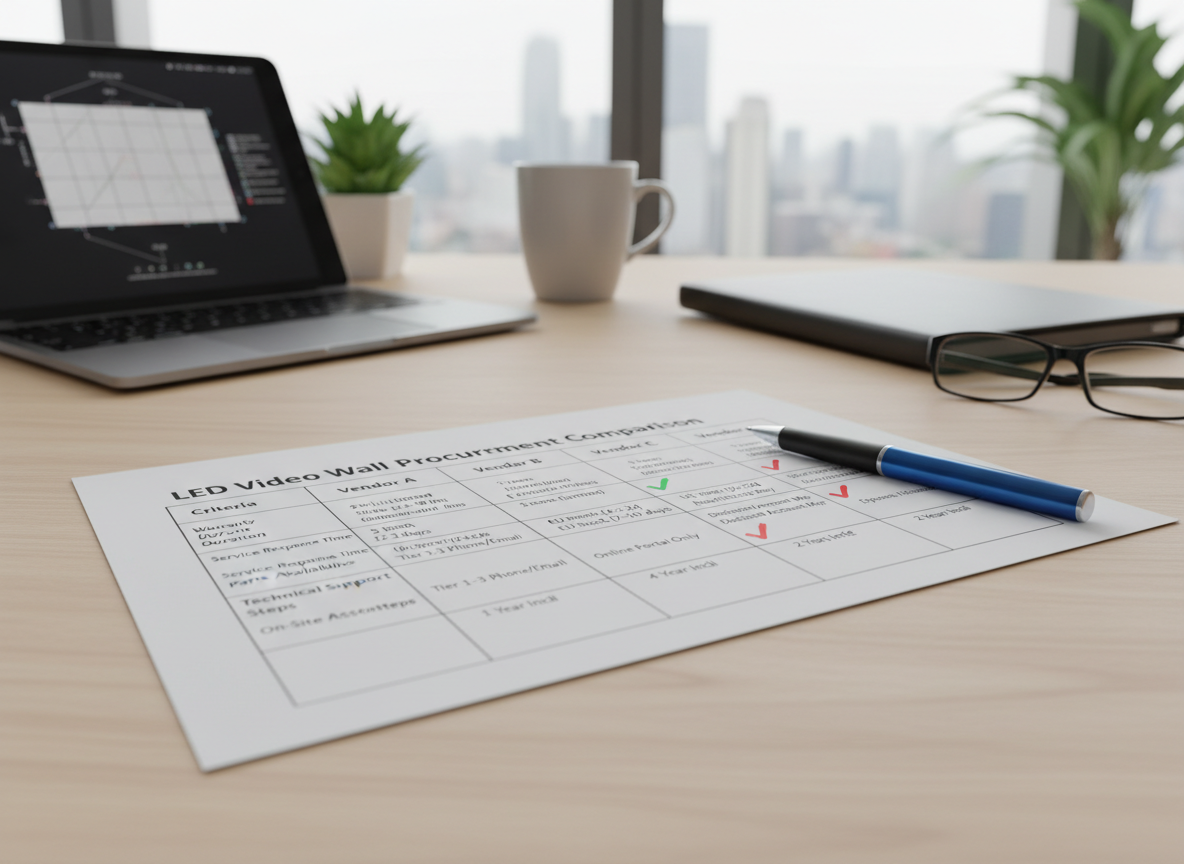
The headline warranty length matters, but it should never be the only number you look at. Buyer-oriented LED wall guides commonly compare enterprise warranties by scope, duration, claim process, on-site service, advanced exchange, and parts access, because those details determine whether the warranty is usable during an outage, not just whether it sounds generous on paper. Enterprise warranty comparison points help frame the comparison, but the real test is the exact policy attached to your quote.
| Warranty dimension | Why it matters in a mission-critical purchase | What to verify | Common red flags |
|---|---|---|---|
| Coverage scope | Tells you what is actually protected | Parts, labor, excluded components, and pixel policy | Vague wording that hides exclusions |
| Term length | Helps with planning, but does not equal fast service | Start and end dates, not just the headline term | A long term with many carve-outs |
| Claim process | A slow claim can extend downtime | Who files the claim and what evidence is needed | Extra steps that delay replacement |
| On-site service | Can reduce recovery time after a fault | Whether service is local, regional, or remote only | Service that depends on distant travel every time |
| Advanced exchange | Helps restore the wall before full repair is complete | Whether a replacement part ships first | No clear replacement path |
| Parts access | A spare part policy can matter more than the term length | Recommended spares and lead times | "Available on request" with no details |
The practical judgment is simple: if a vendor gives you a long warranty but no clear claim path, the warranty is weaker than it looks. If the process is transparent and the parts policy is realistic, a shorter term can still be the safer business choice.
Local Support Footprint Changes TCO
Support geography changes the real cost of ownership because it affects shipping, escalation, labor, and how long the wall stays dark after a failure. That is why the local support and downtime cost discussion matters. A lower sticker price can be offset later by freight, delayed parts, and more service travel than the initial budget assumed.
For a command room or other operational display, the difference is not abstract. If a boardroom wall fails, a next-day fix may be annoying. If a control-room wall fails, even a short delay can create a bigger operational problem. That is why local warehousing, spare-parts access, and clear escalation paths belong in the TCO conversation.
A useful planning rule is to think in cost buckets instead of exact savings claims. The most affected buckets are usually downtime, freight, service labor, and replacement risk. Exact shares vary by site, but the direction is consistent: support closer to the buyer usually lowers recovery friction.
What to Ask About Spare Parts and Response
Use these questions in vendor review:
- Which parts are stocked domestically or regionally?
- What is the escalation path if a fault appears after go-live?
- Who supports installation issues versus warranty claims?
- How are replacement modules or controllers handled?
- What maintenance steps are expected from the buyer’s team?
If the answers stay vague, the support footprint is probably weaker than the brochure suggests. If the answers are specific, process-based, and tied to the actual project, the offer is easier to trust.
How Support Footprint Enters Five-Year TCO
Five-year value is usually decided by more than the purchase price. Initial CAPEX may be only part of the story, while power, maintenance, freight, and outage recovery shape the rest. A cheaper wall can still become the more expensive wall if the service model creates recurring delays or labor surprises.
That is why support footprint should be treated as a financial variable, not just a convenience feature. The buyer does not need a perfect model to make a better decision. They only need enough structure to compare how each vendor handles parts, travel, and recovery time.
How to Weigh Certification and Reliability Claims
When a vendor says a wall is enterprise-grade, rank the claims by trust level. Start with official documentation, then check third-party tests or certifications, then review design features, and only after that give weight to marketing language. That order keeps broad promises from outranking evidence.
A practical way to think about it is this: certification tells you a standard was met in a defined scope, while design features tell you the wall may be easier to service or operate. Neither one alone proves the display is right for your room, duty cycle, or maintenance plan.
If the documentation is strong but the service model is weak, the wall may still be a poor fit. If the service model is strong but the paperwork is thin, you may still face approval or procurement friction. The better choice is the one where both sides line up.
A Practical Buyer Ranking
Use this order when claims conflict:
- Official test files and certification documents
- Third-party verification or clearly named test scope
- Serviceability details, including access and spare parts
- Installation fit for the actual room and control setup
- General marketing claims
That ranking is useful because it forces the vendor to prove the parts of the offer that matter most when the wall is in use. It also keeps you from paying for vague prestige when the decision really depends on documentation and support.
If you want to compare a specific mission-critical family after you have the paperwork in hand, review the mission-critical LED walls path as a navigation starting point, then check the current documentation for your exact build before buying. For broader control-room planning, the command center options page is also a useful check-before-buying stop, especially when you need to verify support scope rather than assume it.
Buyer Checklist Before You Shortlist
Before you shortlist a value-premium LED wall, verify these points:
- Ask for the exact certification or test files tied to the model you are buying.
- Compare what the warranty covers, not just how long it lasts.
- Check whether replacement parts are easy to get and who manages claims.
- Confirm how the wall will be serviced in your room layout.
- Ask how installation help, commissioning, and post-install support are handled.
- Review whether the support path is local, regional, or remote only.
- If a claim sounds broad, ask for the document that proves it.
If you want a narrower browse path after that review, compare the C-Max platform for general indoor use or the zero-downtime COB video wall path for a more mission-critical fit check. Use them as navigation aids, then validate the current spec sheet and support terms before you commit.
Final Takeaway
A value-premium LED wall earns its place when the evidence is stronger than the price tag is tempting. The best buyers compare documentation, warranty usability, service access, and support footprint before they compare prestige. If the numbers look good but the recovery plan is vague, keep shopping. If the paperwork is clear and the service path is practical, a lower-cost wall can be the smarter long-term buy.
FAQs
Are Budget LED Walls Reliable Enough for 24/7 Use?
They can be, but only when the documentation, design, and support model match the actual installation. Price alone does not tell you whether the wall is ready for a 24/7 environment, and a good-looking spec sheet does not replace service planning.
What Warranty Details Matter Most for Mission-Critical LED Walls?
Coverage scope, claim process, parts access, and on-site service matter more than the headline term by itself. A long warranty can still be hard to use if replacement parts, escalation, or service steps are unclear.
How Does Local Support Affect Five-Year TCO?
Local support can reduce freight, travel, and outage recovery friction, which changes the real cost of ownership over time. The exact impact varies by site, but the direction is usually clear: easier access to service tends to lower risk.
Can Certification Files Reduce Procurement Risk?
Yes, because they help verify that a product was tested against a defined safety or compliance scope. They do not replace project-specific due diligence, but they do make it easier to screen out weak or vague claims.
What Should I Ask Before Shortlisting a Value-Premium LED Wall?
Ask for the exact test files, warranty terms, parts policy, service path, and installation support process. If those answers are vague, the wall may be harder to justify for a mission-critical deployment.
How Do I Compare Value-Premium LED Wall vs Top Brands?
Compare the proof, not the logo. If a lower-cost option has clearer documentation, better service access, and a more practical warranty path, it may be the stronger business choice for your project.